TL;DR:
- Dental hygiene prevents systemic inflammation by maintaining oral health and avoiding gum disease. Modern hygienists perform advanced assessments and screenings beyond simple cleaning to support overall wellness. Regular daily practices and professional visits are essential for long-term oral and systemic health, confidence, and cost savings.
Dental hygiene is defined as the daily and professional practice of keeping your teeth, gums, and mouth free from disease and decay. Its role extends far beyond a clean smile. Oral diseases affect an estimated 3.7 billion people worldwide, making poor oral health one of the most widespread health challenges on the planet. That figure means more people live with untreated oral disease than with diabetes and heart disease combined. For adults in Fulham, London and surrounding areas like Parsons Green, Hammersmith, and Chelsea, understanding the importance of oral hygiene is the first step towards protecting both your health and your confidence.
How does dental hygiene impact overall health beyond the mouth?
The mouth is not a sealed system. Bacteria from the gums can enter the bloodstream and trigger inflammation throughout the body. Chronic inflammation caused by periodontal disease contributes to systemic inflammation that may affect the heart, brain, and other organs. This is the biological mechanism that connects your gum health to conditions you might never associate with your teeth.
The evidence for this connection is growing. Research shows that removing financial barriers to preventive dental care in older adults could prevent 2–4% of major health events, including heart attacks and dementia. That is not a trivial number. It means that skipping your hygiene appointments carries a risk that goes well beyond tooth loss.
The relationship between oral health and systemic disease works in both directions. Diabetes and periodontal disease share a reciprocal relationship: poorly controlled blood sugar worsens gum disease, and untreated gum disease makes blood sugar harder to manage. Understanding this bidirectional link helps patients provide better health histories and receive more tailored preventive care. Your dentist or hygienist needs to know about your wider health, not just your teeth.
Key systemic conditions linked to poor oral hygiene include:
- Cardiovascular disease: Oral bacteria can contribute to arterial inflammation and plaque build-up.
- Type 2 diabetes: Gum disease worsens insulin resistance and glycaemic control.
- Dementia: Chronic oral inflammation has been associated with cognitive decline in long-term studies.
- Respiratory infections: Bacteria from the mouth can be inhaled into the lungs, increasing infection risk.
- Adverse pregnancy outcomes: Periodontal disease is linked to premature birth and low birth weight.
Pro Tip: If you notice bleeding gums, persistent bad breath, or loose teeth, treat these as health indicators, not just dental inconveniences. They may signal systemic inflammation worth discussing with your GP as well as your dentist.
What are the evolving roles of dental hygienists in modern care?
The dental hygienist’s role has changed significantly. Historically, hygienists focused on scaling and polishing. Today, they function as prevention and diagnostic partners within the dental team. Dental hygienists now perform risk assessments including oral cancer screening, airway and sleep disorder screening, and microbiome analysis. These are clinical functions that directly influence treatment planning.

Technology has accelerated this shift. Advanced tools like salivary diagnostics, microbial DNA analysis, and AI-assisted imaging allow hygienists to detect disease at a biological level, long before visible symptoms appear. This moves care from reactive cleaning to proactive health management. You can read more about technology in dental clinics and how these advances are reshaping patient care.
The regulatory picture reflects this expanded scope. In 2026, 42 US states allow dental hygienists to independently provide prophylaxis, yet only 3 states formally recognise dental hygiene diagnosis in practice acts. This gap between what hygienists can do clinically and what regulations formally acknowledge is a live debate in dental healthcare. In the UK, the General Dental Council defines the scope of hygienist practice, and private practices like Bespokedentalfulham are well placed to offer the full breadth of preventive care within that framework.
Modern hygienists also act as early warning systems. Their clinical documentation, including periodontal charting and detailed risk assessments, feeds directly into your overall treatment plan. This is not administrative paperwork. It is diagnostic data that shapes the care you receive.
The expanded responsibilities of a modern hygienist include:
- Periodontal charting and disease staging
- Oral cancer screening using visual and tactile examination
- Airway assessment and sleep disorder risk flagging
- Salivary pH and bacterial load analysis
- Patient education on oral-systemic health connections
- Referral pathways to medical colleagues when systemic risk is identified
Pro Tip: At your next hygiene appointment, ask your hygienist whether they offer salivary diagnostics or oral cancer screening. These services are available at private practices and provide information that a standard check-up alone may not capture.
What dental hygiene practices should adults follow daily?
Daily practices including brushing twice a day, flossing, healthy eating, and regular professional visits are the most effective approach to long-term oral health. This is not complicated advice, but the execution matters. Most adults brush for under a minute when two full minutes is the clinical standard.
Follow this evidence-based daily routine:
- Brush for two minutes, twice daily. Use a fluoride toothpaste and a soft-bristled brush. Hold the brush at a 45-degree angle to the gum line and use short, circular strokes rather than scrubbing horizontally.
- Floss once a day. Flossing removes plaque from between teeth where your brush cannot reach. Interdental brushes or water flossers are effective alternatives if traditional floss is difficult to use.
- Limit sugar and acidic foods. Bacteria in the mouth feed on sugar and produce acid that erodes enamel. Reducing frequency of sugary snacks matters more than total quantity.
- Drink water throughout the day. Water rinses food particles and maintains saliva flow. Saliva is your mouth’s natural defence against bacterial overgrowth.
- Attend professional hygiene appointments every 3–6 months. Regular professional hygiene appointments support plaque and tartar removal, gum disease prevention, and early intervention. Home care alone cannot remove calcified tartar.
Pro Tip: Replace your toothbrush or electric brush head every three months, or sooner if the bristles are frayed. A worn brush removes significantly less plaque than a fresh one.
Avoiding common pitfalls is as important as following good habits. Rinsing with water immediately after brushing washes away the fluoride your teeth need. Brushing too hard damages enamel and recedes gums. Using a mouthwash with alcohol can dry out oral tissues and disrupt the healthy microbiome. For personalised guidance on dental wellness in London, a private hygiene appointment gives you advice tailored to your specific oral environment.
What benefits does consistent dental hygiene provide long-term?
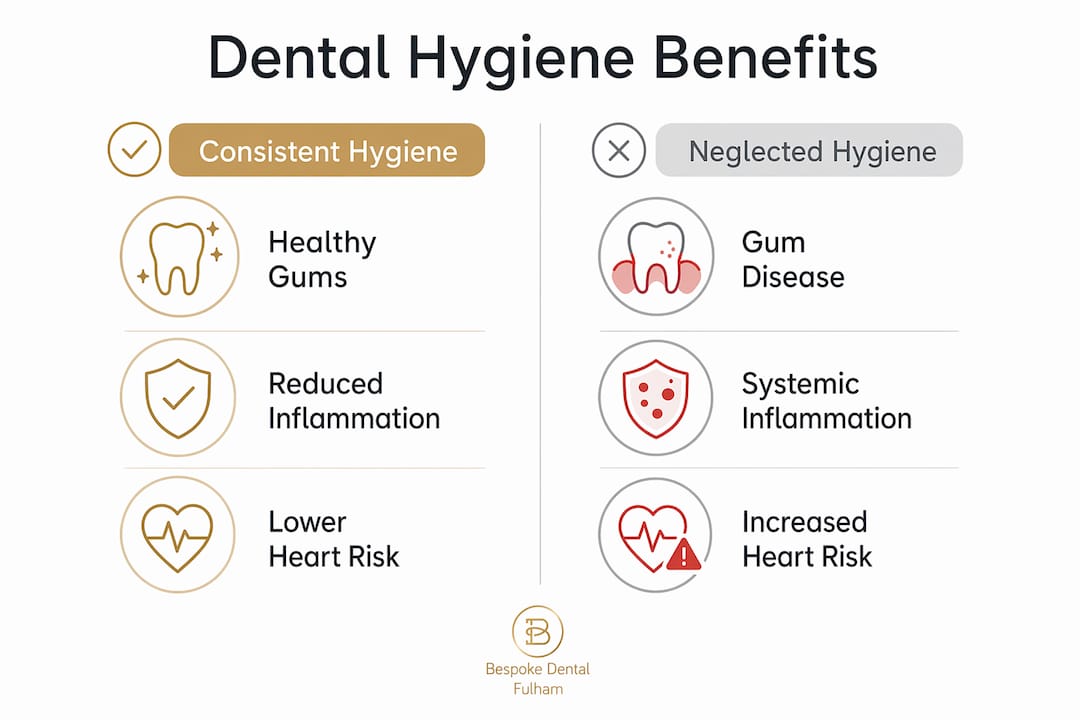
Consistent dental hygiene practices deliver benefits that compound over time. Patients who maintain good oral health keep their natural teeth longer, spend less on restorative treatment, and carry a lower burden of systemic inflammation. Patients who understand the oral-systemic health connection are also better equipped to give comprehensive medical histories, which leads to more tailored preventive strategies from their dental team.
The confidence dimension is real and measurable. A healthy mouth supports clear speech, comfortable eating, and a smile you are not self-conscious about. Research consistently links oral appearance to professional and social confidence. The benefits of cosmetic dentistry are amplified when they are built on a foundation of good hygiene. Veneers, whitening, and bonding all perform better and last longer on healthy gum tissue.
| Area of benefit | With consistent hygiene | With neglected hygiene |
|---|---|---|
| Gum health | Stable, pink, non-bleeding gums | Bleeding, receding, inflamed gums |
| Tooth retention | Natural teeth preserved longer | Higher risk of tooth loss |
| Systemic health | Reduced inflammatory load | Elevated risk of cardiovascular and metabolic disease |
| Treatment costs | Lower long-term dental spend | Higher restorative and emergency costs |
| Smile confidence | Consistent, supported by clean aesthetics | Compromised by staining, odour, and visible disease |
The financial argument for preventive care is straightforward. A professional hygiene appointment costs a fraction of a crown, implant, or periodontal treatment. Investing in prevention is not just good health practice. It is sound financial planning for your long-term dental care.
Key takeaways
Dental hygiene is the single most cost-effective intervention for protecting both oral health and systemic wellness, requiring consistent daily practice and regular professional care.
| Point | Details |
|---|---|
| Oral health affects whole-body health | Periodontal disease drives systemic inflammation linked to heart disease, diabetes, and dementia. |
| Hygienists do more than clean | Modern hygienists screen for oral cancer, assess airway risk, and use diagnostic technology to detect disease early. |
| Daily routine is non-negotiable | Brushing twice daily, flossing, and limiting sugar form the evidence-based foundation of oral health. |
| Professional visits prevent costly treatment | Regular hygiene appointments remove tartar and enable early intervention before disease progresses. |
| Good hygiene supports smile confidence | Healthy gums and clean teeth are the foundation for any aesthetic dental treatment to succeed and last. |
Why I think most people underestimate their hygienist
Patients often arrive at a hygiene appointment expecting a clean and a polish. What they receive, at a good private practice, is something closer to a health audit. Over the years, I have seen hygienists identify early-stage gum disease, flag suspicious lesions for further investigation, and pick up signs of acid reflux from enamel erosion patterns. None of these findings came from a dentist’s check-up. They came from a hygienist paying close attention during a routine appointment.
The conventional view of oral hygiene as cosmetic maintenance misses the point entirely. Oral health is a critical part of total body wellness, and daily hygiene is a low-cost intervention that prevents systemic inflammation and chronic disease. That framing changes how you should think about your six-monthly appointment. It is not a luxury. It is preventive medicine.
What I find most encouraging is the direction the profession is heading. Dental hygiene is transitioning from task-based cleaning to chairside biology and patient empowerment, addressing root causes rather than surface symptoms. Patients who engage with this shift, who ask questions, who understand why their gum health matters to their cardiologist, get better outcomes. The information is available. The appointments are accessible. The only barrier is treating oral health as an afterthought.
My advice is simple. Book your hygiene appointment with the same seriousness you give a GP visit. Come prepared to discuss your full medical history. Ask what your hygienist found, not just what they cleaned. That conversation is where the real value lies.
— Amit
Dental hygiene therapy at Bespokedentalfulham in Fulham
Bespokedentalfulham offers private dental hygiene therapy for patients across Fulham, Parsons Green, Hammersmith, Putney, and Chelsea. Appointments go beyond standard cleaning to include periodontal assessment, personalised oral health advice, and early disease detection in a calm, discreet clinic environment.
Good hygiene is also the foundation for any aesthetic treatment to perform at its best. Whether you are considering smile enhancement options or simply want to protect the teeth you have, a professional hygiene appointment is the right starting point. Contact Bespokedentalfulham to book your appointment in SW6 and take a grounded, evidence-based approach to your oral health.
FAQ
What is the role of dental hygiene in overall health?
Dental hygiene prevents gum disease and reduces the oral bacteria that drive systemic inflammation, lowering the risk of heart disease, diabetes complications, and dementia. It is a direct intervention for whole-body health, not just oral care.
How often should adults have a professional hygiene appointment?
Most adults benefit from a professional hygiene appointment every 3–6 months, depending on their gum health and risk profile. Patients with a history of periodontal disease may need more frequent visits.
Can poor dental hygiene affect my heart?
Yes. Chronic periodontal disease contributes to systemic inflammation that is associated with cardiovascular disease and stroke. Preventive dental care reduces this inflammatory burden.
What do dental hygienists do beyond cleaning teeth?
Modern dental hygienists perform oral cancer screening, airway risk assessments, periodontal charting, and use tools like salivary diagnostics and AI imaging to detect disease at an early stage.
Why is dental hygiene important for a confident smile?
Healthy gums and clean teeth are the foundation for any aesthetic treatment, including whitening, veneers, or bonding. Good hygiene prevents staining, bad breath, and gum recession, all of which affect how your smile looks and feels.