TL;DR:
- Dental implants are titanium posts surgically placed into the jawbone to replace missing tooth roots. They stimulate the jawbone like natural roots, preventing bone loss and supporting facial structure. Implants last decades, restore function and aesthetics, and are suitable for patients of various ages with good health and bone density.
Dental implants are titanium posts surgically placed into the jawbone to replace missing tooth roots, providing a permanent and natural-feeling solution for tooth loss. Understanding why dental implants are beneficial starts with one fact: they are the only tooth replacement option that stimulates the jawbone the way a natural root does. Over 3 million Americans have already chosen implants, with adoption growing by roughly 500,000 patients each year. That scale reflects a clear clinical consensus. For adults in Fulham and London weighing their options, implants offer advantages in function, bone health, aesthetics, and long-term value that no other solution matches.
How do dental implants restore natural chewing function and oral health?
Dental implants restore chewing power to a level very close to natural teeth. Unlike removable dentures, which can shift during eating and limit the foods you feel confident biting into, an implant is anchored directly into the bone. That stability means you can eat normally without adjusting your diet or worrying about movement.
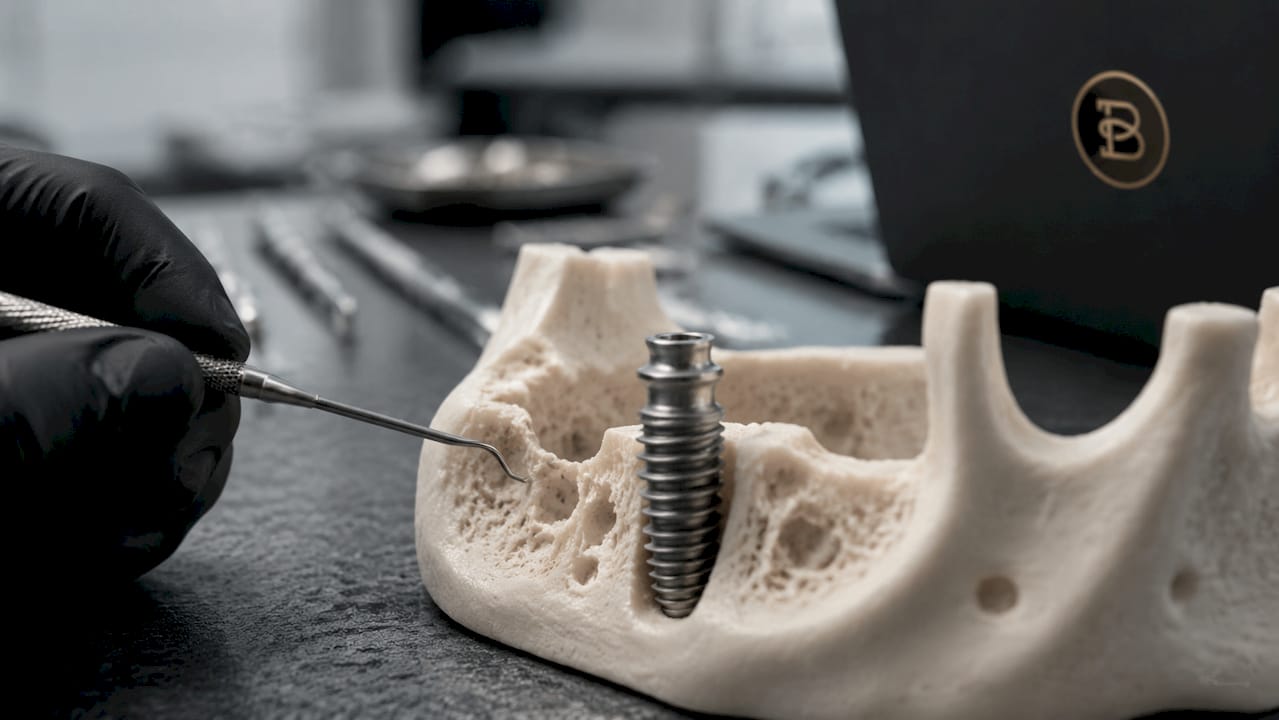
Oral hygiene is also significantly simpler with implants. Implants are cleaned like natural teeth using a toothbrush and floss, with no need for removal, adhesives, or soaking solutions. That ease of maintenance reduces the risk of plaque build-up around the restoration and supports the health of surrounding gum tissue.
Implants also protect neighbouring teeth in a way that traditional bridges cannot. A bridge requires grinding down the healthy teeth on either side to act as anchors. Bridges cause damage to adjacent teeth, with roughly 30% of those teeth requiring root canal treatment within 10 years due to the trauma involved. An implant stands independently, leaving neighbouring teeth completely untouched.
- Restores near-natural bite force and chewing stability
- Allows normal brushing and flossing without removal
- Protects adjacent teeth from grinding or structural compromise
- Eliminates the need for denture adhesives or overnight soaking
- Supports healthy gum tissue through stable, fixed placement
Pro Tip: If you are comparing implants with a bridge, ask your dentist to explain the long-term impact on the teeth either side of the gap. The difference in risk to those teeth is often the deciding factor for patients in Fulham.
In what ways do dental implants help preserve jawbone and facial structure?
Bone loss after tooth extraction is faster than most patients expect. Roughly 25% of jawbone width is lost in the first year after a tooth is removed without replacement. That loss continues gradually over time, changing the shape of your face and weakening the foundation for any future dental work.
Dental implants prevent this by mimicking the mechanical function of a natural tooth root. When you chew, the titanium post transmits pressure into the bone through a process called osseointegration, where the bone fuses directly to the implant surface. This stimulation signals the body to maintain bone density in that area, halting the resorption process.
Board-certified periodontists define implants as the gold standard for tooth replacement precisely because of this bone preservation effect. No other option replicates it. Dentures sit on top of the gum and provide no root stimulation at all. Bridges preserve the crown space but leave the underlying bone unstimulated.
| Replacement type | Bone stimulation | Bone loss prevention | Facial structure support |
|---|---|---|---|
| Dental implant | Yes, via osseointegration | Full prevention | Maintained long-term |
| Denture | None | No | Gradual deterioration |
| Bridge | None below the gap | No | Gradual deterioration |
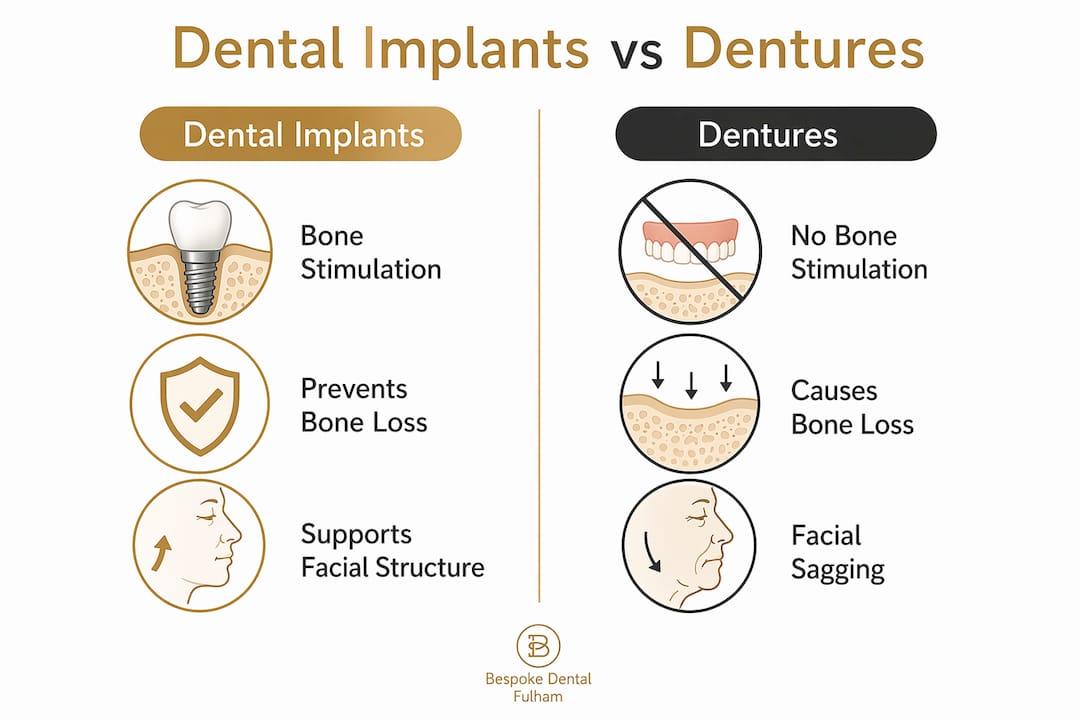
Dentures result in bone loss and a sunken facial appearance over time as the jaw shrinks beneath them. Patients who have worn full dentures for many years often notice their lower face appears shorter or collapsed. Implants prevent that outcome entirely by keeping the bone active and intact.
Pro Tip: If you have already experienced some bone loss after an extraction, do not assume implants are out of reach. Bone grafting procedures can rebuild sufficient density to support an implant. Ask about this at your consultation with Bespokedentalfulham.
What are the longevity and durability advantages of dental implants?
Dental implants are built to last decades, not years. Studies show 95–98% survival rates at the 10-year mark, and many implants remain fully functional at 25 years and beyond with proper care. That level of durability is unmatched by any other tooth replacement option currently available.
The implant itself is made from medical-grade titanium, which is biocompatible and highly resistant to corrosion. The crown placed on top typically lasts 10–15 years before it may need replacing, depending on wear and oral hygiene habits. The titanium root, once integrated, rarely requires intervention.
- Titanium post: Designed to last a lifetime with good oral health
- Implant crown: Typically lasts 10–15 years before replacement is considered
- Dentures: Often require relining or full replacement every 5–7 years
- Bridges: Average lifespan of 10–15 years, with risk of damage to anchor teeth
The economic case for implants becomes clear over a 20-year horizon. Dentures and bridges require ongoing costs: adhesives, relining, repairs, and eventual replacement. An implant is a single investment that, with good maintenance, eliminates most of those recurring expenses. For patients in London considering the long-term cost of tooth replacement, implants frequently prove more cost-effective over time than they first appear.
Patient behaviour plays a significant role in implant lifespan. Smoking, uncontrolled diabetes, and poor oral hygiene all increase the risk of peri-implantitis, an infection of the tissue around the implant. Patients who maintain regular hygiene appointments and brush thoroughly around the implant site consistently achieve the best long-term outcomes.
How do dental implants improve aesthetics and confidence in London?
Dental implants look and feel like natural teeth. The crown is colour-matched to your surrounding teeth and shaped to fit your bite precisely. There are no metal clasps visible at the gum line, no movement when you speak, and no risk of the restoration slipping at an inconvenient moment.
For adults in Fulham and London, where professional and social confidence matters, these details are not trivial. Improved speech clarity and greater confidence are consistently reported by patients who switch from ill-fitting dentures to implants. The difference in how you present yourself in conversation, at work, and in social settings is immediate and lasting.
- Natural appearance with colour-matched, custom-shaped crowns
- No visible metal clasps or removable components
- Stable fit that does not shift during speech or eating
- Improved pronunciation and clarity compared to dentures
- Restored smile symmetry supporting natural facial expression
Patients who have lived with a gap or an uncomfortable denture for years often describe getting an implant as reclaiming a part of themselves. The psychological benefit of a stable, natural-looking tooth is significant and well-documented. For those exploring the full range of smile enhancement options available in Fulham, implants sit at the foundation of any comprehensive aesthetic plan.
What practical factors affect dental implant success?
Good overall health is the most important factor in implant success. Age is not a primary barrier; systemic health, bone density, and commitment to maintenance matter far more. Patients with well-managed health conditions, sufficient bone volume, and strong oral hygiene habits are excellent candidates regardless of their age.
The treatment timeline is predictable. The full process takes 3–6 months from the surgical placement of the implant to the fitting of the final crown. That period allows the bone to integrate fully with the titanium post before any load is placed on it.
- Initial assessment: Bone density scans and health review to confirm suitability
- Implant placement: Titanium post placed under local anaesthetic
- Osseointegration period: 3–6 months for bone to fuse with the implant
- Crown fitting: Custom crown attached once integration is confirmed
- Ongoing maintenance: Regular hygiene appointments and daily brushing around the implant site
Common pitfalls include smoking during the healing period, skipping hygiene appointments, and failing to disclose health conditions such as diabetes or blood-thinning medication. Patients who are transparent with their dental team and follow aftercare guidance consistently achieve the best results. You can read more about managing implant health for a detailed breakdown of what long-term care involves.
Pro Tip: If your bone density is borderline, do not rule out implants before speaking to a clinician. Bone grafting has become a routine preparatory procedure, and many patients who were initially told they lacked sufficient bone have gone on to receive successful implants.
Key takeaways
Dental implants are the only tooth replacement option that prevents jawbone loss, restores near-natural function, and delivers lasting aesthetic results across a patient’s lifetime.
| Point | Details |
|---|---|
| Bone preservation | Implants prevent the 25% first-year bone loss that follows tooth extraction without replacement. |
| Long-term durability | Studies show 95–98% survival at 10 years, with many implants lasting 25 years or more. |
| Natural function and hygiene | Implants are cleaned like natural teeth and restore near-natural chewing force without adhesives. |
| Aesthetic and confidence benefits | Custom crowns are colour-matched and stable, improving speech, smile, and daily confidence. |
| Health over age | Systemic health and bone density determine suitability, not age, widening access for older adults. |
Why I think implants are the most honest investment in dental health
Patients often come to me having spent years managing a denture that never quite fitted, or avoiding certain foods because of a gap they felt self-conscious about. When I explain the bone loss that has been quietly happening beneath the surface during that time, the conversation changes. The question shifts from “are implants worth it?” to “why did I wait so long?”
What I find most compelling about implants is not the aesthetics, though those matter enormously to patients in London. It is the biology. An implant is the only restoration that actually preserves the structure of your face over time. Everything else is a workaround. Dentures and bridges address the visible gap but leave the underlying bone to deteriorate. That deterioration compounds over years in ways that become harder and more expensive to address.
The patients I see who are most satisfied with their implants are those who understood from the outset that they were making a long-term decision, not a quick fix. They committed to the maintenance, attended their hygiene appointments, and treated the implant like the investment it is. The results speak for themselves. If you are weighing up implants versus other treatments, I would encourage you to look beyond the upfront cost and consider what each option does, or does not do, for your bone health over the next 20 years.
— Amit
Dental implants at Bespokedentalfulham in Fulham, London
Bespokedentalfulham offers a full range of implant treatments at its boutique practice in Fulham, SW6, applying Harley Street standard techniques in a calm and discreet environment. Each patient receives a personalised treatment plan based on detailed bone density assessment, digital imaging, and a thorough health review.
Whether you are replacing a single tooth or considering a more extensive restoration, the team at Bespokedentalfulham guides you through every stage with clarity and care. Patients across Fulham, Parsons Green, Chelsea, Hammersmith, and Putney choose the practice for its combination of clinical precision and genuinely personal attention. To find out whether implants are right for you, visit the dental implants in Fulham page and book your consultation today.
FAQ
What makes dental implants better than dentures?
Dental implants integrate with the jawbone and prevent bone loss, while dentures sit on the gum and allow bone to deteriorate over time. Implants also require no adhesives and are cleaned like natural teeth.
How long do dental implants last?
Studies show 95–98% survival rates at 10 years, and many implants remain functional for 25 years or more with good oral hygiene and regular dental check-ups.
Are dental implants suitable for older adults?
Age is not the primary factor. Systemic health, bone density, and commitment to aftercare determine suitability, making implants accessible to many older patients who are otherwise in good health.
How long does the dental implant process take?
The full process from surgical placement to fitting the final crown typically takes 3–6 months, allowing time for the bone to fuse fully with the titanium implant.
Do dental implants affect neighbouring teeth?
Implants stand independently and leave adjacent teeth untouched. Traditional bridges, by contrast, require grinding down healthy neighbouring teeth, which increases the risk of those teeth needing root canal treatment over time.